It is currently Wed 27 May 2026 10:31 am

All times are UTC


Forum rules


Please click here to view the forum rules


Post new topic Reply to topic  [ 4 posts ] 
Author Message
PostPosted: Mon 10 Apr 2023 4:03 pm 
Offline

Joined: Thu 27 May 2021 3:22 am
Posts: 1751
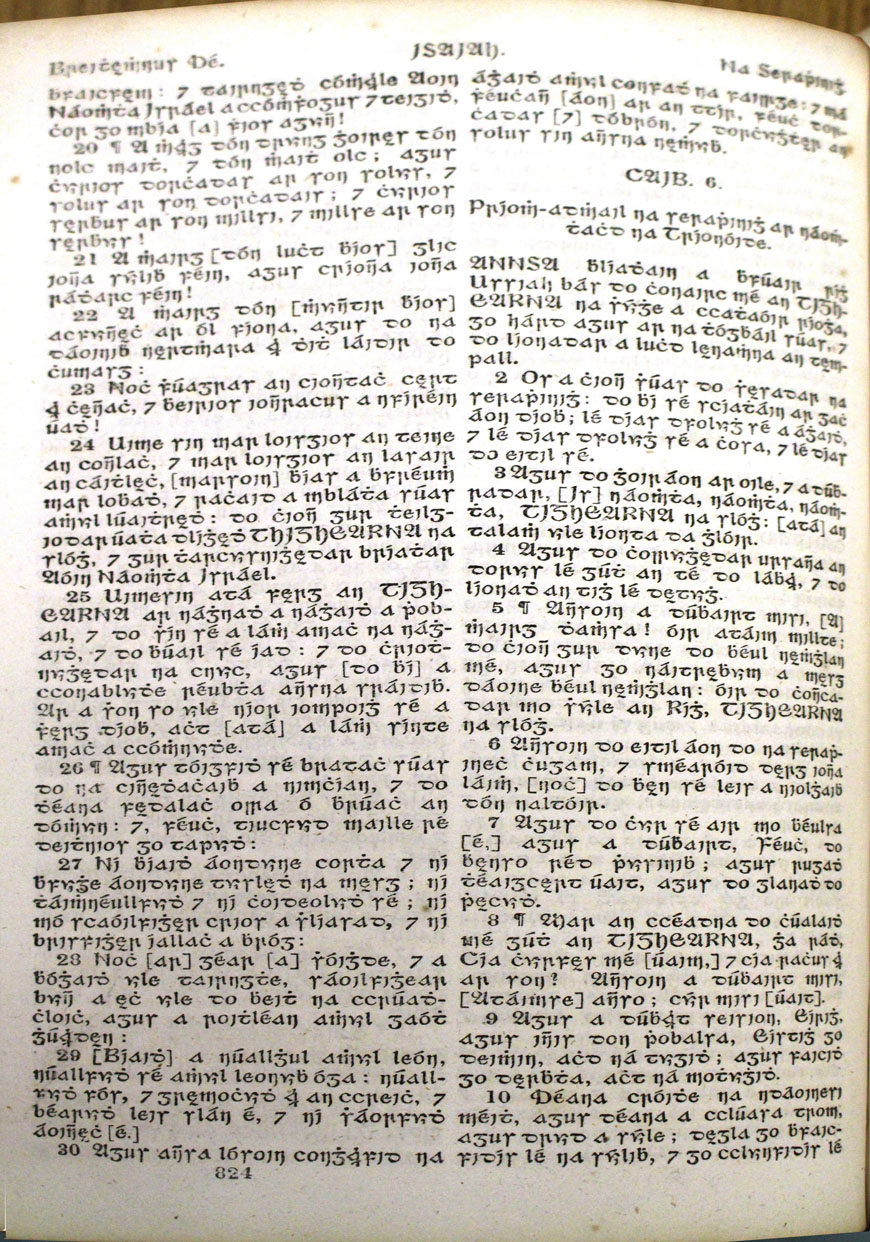
http://www.bawnboy.com/first-irish-bibl ... pter-6.jpg
[I can't post the image, as the forum software says you can't post images with a width of more than 800 pixels, and if you resize it down to 800 pixels, it then says "It was not possible to determine the dimensions of the image". I think this is a known problem with phpbb software.]

Here you see Bedell's Bible - not the original manuscript of the mid-1600s, but the later printed version, printed in seana-chlódh with the manuscript abbreviations.

This is from a website that gives this image. It also links to someone (Michael Glenfield - who is this?) reading Isaiah 6:1-8, supposedly from Bedell's Bible, but as you can see the audio at http://www.bawnboy.com/first-irish-bible-translated-at-templeport/m-glenfield-bedell-isiah6-1-8a.mp3 is not of Bedell's translation at all - and the pronunciation is simply dreadful. It makes me realise that the day when the Gaelthacht is over and all speakers of Irish speak like this person is the day when the teaching of Irish should stop.

Let's look at the image of Isaiah 6:1-6 (so as not to go for too long):
1. You will notice a tendency to mark the stress on a word with no long á, é, í, ó or ú vowel with a síneadh fada (bhlíadhain and bhfúair in verse 1). I mean: aon appears as áon, as the pronunciation is e:n, although the digraph is ao, and yet has a síneadh fada. Also diphthongs tend to have the síneadh fada, see ághaidh for aghaidh later on.
2. chonairc = the later chonaic
3. na shúighe: you will notice the manuscript style combined "ui" letter, and as marking of the stress on that letter, which makes it look like shúighe instead of shuíghe.
4. a ccathaóir: = i gcathaoir. The pronunciation of the unstressed word "i" is normally "a", and cc is an older way of writing gc.
5. luchd = lucht
6. in leanamhna and teampall in verse 1, you see that "ea" is written with the manuscript abbreviation (e with a squiggle under it)
7. Verse 2: chionn: nn written with the abbreviation n with a line over it. Sheasadar has the ea abbreviation. You see sc- and not sg- for scíatháin here (despite the d in lucht in verse 1).
8. Verse 4: corruigheadar: the manuscript abbrevition for rr, the ui combined letter and the abbreviation for ea are used here. Ursanna has the abbreviation mentioned above. An té do lábhair has the manuscript abbreviation for "air". Deatuigh: has the ea abbreviation.
9. Verse 5: annsoin for ansan, misi for mise, dhamhsa for dhómhsa. You notice that "do chíonn" always has "do" attached to it. Chonncadar = chonacadar.
10. Verse 6: noch - an old relative particle.
11. noch do bheann sé leis a niolghaibh dón naltóir: which he took with his tongs from the altar, but I don't know why "bheann" has this meaning, and I don't know this word for "tongs". (I see DIL has an entry for iolgaibh, meaning "tongs", referenced to this exact passage only. For "bheann" see benaid in DIL, meaning f).

In 1817 a clódh Rómhánach edition of Bedell's Bible was published, without changing any of the spellings. You can read this page in that edition at https://www.google.co.uk/books/edition/ ... frontcover


Top
 Profile  
 
PostPosted: Mon 10 Apr 2023 6:09 pm 
Offline

Joined: Fri 08 Jan 2016 11:37 pm
Posts: 279
djwebb2021 wrote:
1. You will notice a tendency to mark the stress on a word with no long á, é, í, ó or ú vowel with a síneadh fada (bhlíadhain and bhfúair in verse 1). I mean: aon appears as áon, as the pronunciation is e:n, although the digraph is ao, and yet has a síneadh fada. Also diphthongs tend to have the síneadh fada, see ághaidh for aghaidh later on.

This is not marking stressed (there’d be fada eg. in a compound where this would be in a later unstressed syllable too). The fada was just used to mark a long syllable (and in mss. it’s somewhere above the syllable, not necessarily the first vowel character), so búail, buáil, buaíl or even b́uail are valid options). Since diphthongs are long, they’re often marked with the fada.

As for the rest – those all were very common in Irish printed texts of the 18th and earlier 19th century. The print didn’t have all the scribal abbreviations, but there were quite a few common, “standard” ones used in print and included in Irish types. Vallancey’s grammar even lists them:

Image

You may also note that here the “tall e” variant is used instead of this ę-like looking ea ligature.

The earlier grammar by Mac Cruitín actually uses seanachló and is full of those abbreviations too. And the type used there even has the spiritus asper (a squibble taken from Greek, like in Ἑλλάς for Hellás; sometimes in the shape of left half of the letter H) instead of punctum delens above some letters (see the ċ below):

Image

(you can also see both taoiḃrm and tuilréim with fada placed inconsistently – cause it doesn’t matter where it is, it just says “this syllable is long”.)

As for spellings like a ttiġ for i dtigh, or as for is (the copula and shortened agus) – those were also very common (and, arguably, make more sense for the unstressed vowel followed by broad consonant…).


Top
 Profile  
 
PostPosted: Mon 10 Apr 2023 6:31 pm 
Offline

Joined: Thu 27 May 2021 3:22 am
Posts: 1751
Ah yes, thank you. The fada marked a long syllable, even one with a diphthong. I see.

What about do bhean sé don naltóir leis a niolghaibh? Is this word iolgha completely obsolete now?

[I see in Dinneen's dictionary that it is do bhean sé (single n).]


Top
 Profile  
 
PostPosted: Tue 11 Apr 2023 3:47 pm 
Offline

Joined: Thu 27 May 2021 3:22 am
Posts: 1751
Interesting to see the names of the cases there. This may be were PUL got giniúnach from. Garmach would be gairmeach, and the accusative gearánach and ablative díobhálach have different names too today (cuspóireach, ochslaíoch).


Top
 Profile  
 
Display posts from previous:  Sort by  
Post new topic Reply to topic  [ 4 posts ] 

All times are UTC


Who is online

Users browsing this forum: Google [Bot] and 513 guests


You cannot post new topics in this forum
You cannot reply to topics in this forum
You cannot edit your posts in this forum
You cannot delete your posts in this forum

Search for:
Jump to:  
Powered by phpBB® Forum Software © phpBB Group